
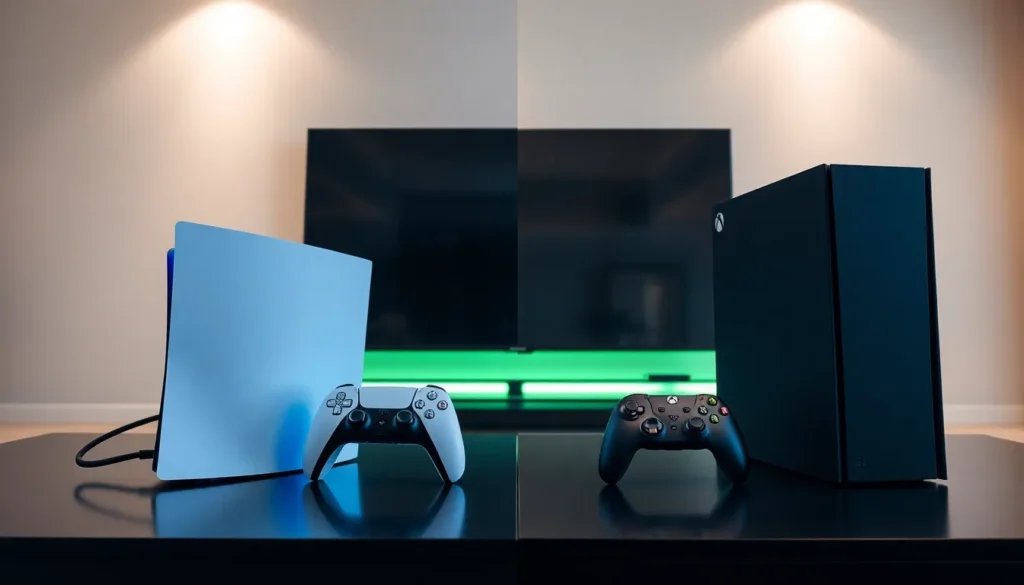

PlayStation vs Xbox remains one of gaming’s biggest debates. Both consoles deliver excellent experiences, but they target different types of players. Sony’s PlayStation 5 and Microsoft’s Xbox Series X represent the latest generation of home gaming hardware. Each platform offers distinct advantages in performance, games, online services, and pricing. This guide breaks down the key differences between PlayStation vs Xbox so readers can make an well-informed choice. Whether someone prioritizes exclusive titles, raw power, or subscription value, this comparison covers what matters most.
Table of Contents
ToggleKey Takeaways
- PlayStation vs Xbox offers distinct strengths: PS5 leads with exclusive story-driven games and faster SSD speeds, while Xbox Series X delivers more raw GPU power and better backward compatibility.
- Xbox Game Pass provides exceptional value with day-one access to first-party titles, making it ideal for players who enjoy trying multiple games.
- The PS5’s DualSense controller offers immersive haptic feedback and adaptive triggers that Xbox’s standard controller doesn’t match.
- For budget-conscious gamers, the Xbox Series S at $299 is the cheapest entry point into current-gen gaming with no PlayStation equivalent.
- PlayStation exclusives like God of War Ragnarök and Spider-Man 2 consistently earn critical acclaim, while Xbox’s Bethesda and Activision acquisitions promise strong future exclusives.
- Your best choice in the PlayStation vs Xbox debate depends on your priorities—exclusive game quality, subscription value, or hardware flexibility.
Console Hardware and Performance Comparison
The PlayStation vs Xbox hardware debate starts with raw specifications. Both the PS5 and Xbox Series X use custom AMD processors and support 4K gaming at up to 120fps. But, there are notable differences in how each console handles performance.
The Xbox Series X features 12 teraflops of GPU power compared to the PS5’s 10.28 teraflops. On paper, Microsoft’s console has a slight edge in raw graphical capability. The Series X also includes 1TB of internal storage, while the PS5 offers 825GB.
Sony counters with its ultra-fast SSD. The PS5’s custom storage solution delivers speeds of 5.5GB/s, nearly double the Xbox Series X’s 2.4GB/s. This translates to faster load times and smoother asset streaming in PlayStation vs Xbox comparisons. Games like Ratchet & Clank: Rift Apart showcase what this speed enables.
The DualSense controller gives PlayStation another advantage. Its haptic feedback and adaptive triggers create immersive gameplay sensations that Xbox’s standard controller doesn’t match. Meanwhile, Xbox controllers maintain excellent ergonomics and widespread compatibility across PC and mobile devices.
For those wanting a budget option, the Xbox Series S costs significantly less than either flagship console. It targets 1440p gaming instead of 4K but still delivers solid performance. PlayStation doesn’t offer a comparable budget alternative in the current generation.
Exclusive Games and Game Library
Exclusive games often decide the PlayStation vs Xbox winner for many players. Sony has built a reputation for single-player, story-driven experiences. Microsoft focuses on variety and accessibility.
PlayStation exclusives include critically acclaimed titles like God of War Ragnarök, Spider-Man 2, Horizon Forbidden West, and The Last of Us Part II. These games consistently receive high review scores and drive console sales. Sony’s first-party studios, Naughty Dog, Santa Monica Studio, Insomniac Games, produce some of gaming’s most polished experiences.
Xbox exclusives have grown stronger following Microsoft’s studio acquisitions. The company now owns Bethesda, Activision Blizzard, and numerous other developers. Franchises like Halo, Forza, Starfield, and Call of Duty fall under the Xbox umbrella. Future titles from these studios will likely remain exclusive or timed-exclusive to Xbox and PC.
The PlayStation vs Xbox library comparison also considers third-party games. Most major releases appear on both platforms simultaneously. Performance differences between consoles are typically minimal for cross-platform titles.
Backward compatibility is another factor. Xbox Series X plays games from every previous Xbox generation. The PS5 supports most PS4 titles but lacks compatibility with PS3, PS2, and PS1 discs. Players with large legacy libraries may find Xbox more appealing.
Both platforms support cross-play for many online games, reducing the importance of where friends play.
Online Services and Subscription Options
Online services represent a major battleground in the PlayStation vs Xbox competition. Both companies offer tiered subscription models, but Xbox Game Pass has changed expectations.
Xbox Game Pass provides access to hundreds of games for a monthly fee. The service includes day-one releases of all Microsoft first-party titles. Subscribers can play new Halo, Forza, and Bethesda games immediately without additional purchase. Game Pass Ultimate bundles online multiplayer, cloud gaming, and EA Play access.
PlayStation’s response is PS Plus, which now offers three tiers: Essential, Extra, and Premium. Essential mirrors the old PS Plus with monthly free games and online play. Extra adds a game catalog similar to Game Pass. Premium includes classic games and cloud streaming.
The PlayStation vs Xbox subscription value depends on usage. Game Pass offers better value for players who try many games. PS Plus Premium appeals to those wanting classic PlayStation titles. Neither service is objectively superior, preferences vary.
Cloud gaming capabilities differ too. Xbox Cloud Gaming lets subscribers stream games to phones, tablets, and browsers. PlayStation’s streaming requires the Premium tier and works on fewer devices. Microsoft holds an advantage here for players wanting portable access.
Online multiplayer quality remains comparable between PlayStation vs Xbox. Both networks experience occasional outages, but neither platform consistently outperforms the other in stability or speed.
Price and Value Considerations
Price plays a significant role in the PlayStation vs Xbox decision. Initial console costs, game prices, and ongoing subscription fees all factor into long-term value.
The PS5 and Xbox Series X launched at $499 for their standard editions. Digital-only versions cost less, $399 for the PS5 Digital Edition at launch and $299 for the Xbox Series S. The Series S offers the cheapest entry point into current-gen gaming.
Game pricing follows industry standards on both platforms. New releases typically cost $69.99. But, Xbox Game Pass subscribers can access first-party games immediately, potentially saving hundreds of dollars annually. PlayStation vs Xbox cost comparisons favor Microsoft for players who would otherwise buy multiple first-party titles.
Accessory costs remain similar. Controllers run about $70 each. Storage expansion options exist for both consoles, though proprietary solutions can be expensive.
Long-term value depends on gaming habits. Someone who buys two to three games yearly might prefer PlayStation’s exclusive quality. A player who samples many titles benefits more from Game Pass. The PlayStation vs Xbox value proposition isn’t one-size-fits-all.
Resale value tends to favor PlayStation consoles historically. PS5 units have maintained strong secondary market prices. This matters for players who upgrade frequently or sell old hardware.


