
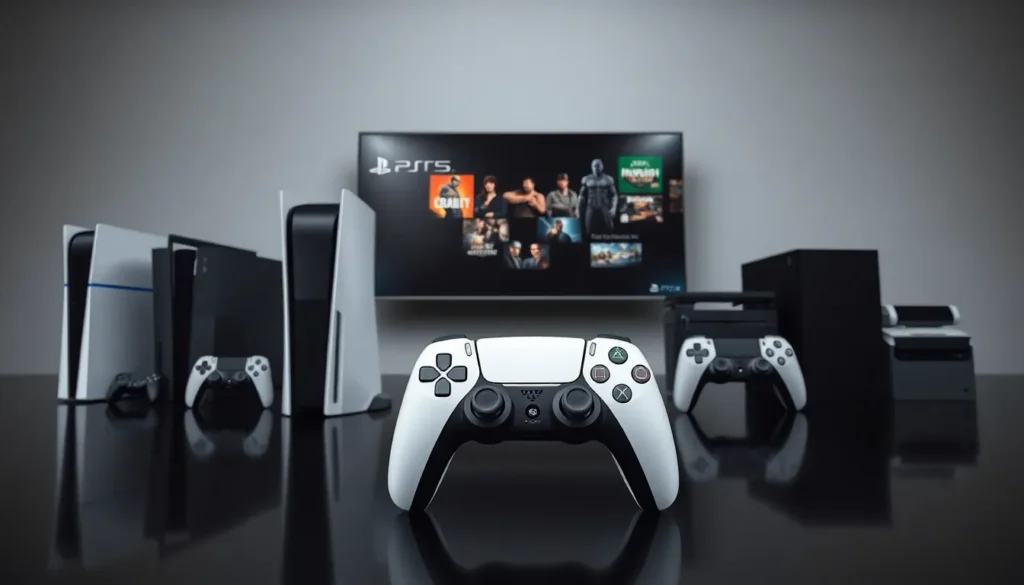

PlayStation examples span nearly three decades of gaming history. From the original 1994 console to the PlayStation 5, Sony has shaped how millions of people play video games. This article examines PlayStation examples across consoles, exclusive titles, accessories, and the brand’s lasting impact on the gaming industry. Whether someone is a longtime fan or a curious newcomer, these PlayStation examples show why the brand remains a dominant force in entertainment.
Table of Contents
ToggleKey Takeaways
- PlayStation examples span nearly three decades, from the 1994 original console to the PS5, showcasing Sony’s evolution in gaming hardware.
- The PlayStation 2 remains the best-selling console of all time with over 155 million units sold, demonstrating how innovation drives consumer adoption.
- Exclusive titles like God of War, The Last of Us, and Spider-Man represent standout PlayStation examples that drive console sales and build loyal fan bases.
- The DualSense controller’s adaptive triggers and haptic feedback set new standards for immersive gameplay experiences.
- PlayStation Network’s 100+ million monthly active users prove Sony’s success in establishing online multiplayer and digital storefronts as console essentials.
- From CD-based gaming to Blu-ray technology, PlayStation examples show how Sony consistently pushed hardware boundaries and shaped industry standards.
Evolution of PlayStation Consoles
Sony launched the original PlayStation in Japan on December 3, 1994. This console introduced CD-based gaming to a mass audience and sold over 102 million units worldwide. It set the stage for future PlayStation examples that would define generations of gamers.
The PlayStation 2 arrived in 2000 and became the best-selling console of all time. With over 155 million units sold, the PS2 offered backward compatibility, DVD playback, and an enormous game library. These features made it a prime PlayStation example of how innovation drives consumer adoption.
Sony released the PlayStation 3 in 2006. This console introduced Blu-ray technology and online gaming through PlayStation Network. While it faced stiff competition from Microsoft’s Xbox 360, the PS3 sold approximately 87 million units and delivered memorable exclusive titles.
The PlayStation 4 launched in 2013 and quickly dominated the eighth console generation. It sold over 117 million units by prioritizing games over multimedia features. The PS4 Pro, released in 2016, added 4K gaming support and improved performance.
PlayStation 5 hit shelves in November 2020. This console features an ultra-fast SSD, ray tracing, and haptic feedback controllers. Even though supply chain challenges, the PS5 has sold over 50 million units and continues to attract players with its speed and graphics. Each console represents a clear PlayStation example of Sony’s commitment to pushing hardware boundaries.
Notable PlayStation Exclusive Games
PlayStation exclusive games represent some of the strongest PlayStation examples in the industry. These titles drive console sales and create loyal fan bases.
God of War stands as a flagship franchise. The 2018 reboot and its 2022 sequel, God of War Ragnarök, earned critical acclaim and commercial success. Kratos’s journey through Norse mythology showcases what PlayStation exclusives can achieve in storytelling and gameplay.
The Last of Us series defines narrative-driven gaming. Naughty Dog’s post-apocalyptic adventure sold millions of copies and inspired an HBO television adaptation. The Last of Us Part II won over 300 Game of the Year awards, making it a standout PlayStation example.
Spider-Man games from Insomniac Games brought Marvel’s hero to life on PlayStation. Spider-Man (2018) and Spider-Man: Miles Morales (2020) combined fluid combat with open-world exploration. Spider-Man 2, released in 2023, continued this success.
Horizon Zero Dawn and Horizon Forbidden West created a unique post-apocalyptic world filled with robotic creatures. Guerrilla Games developed both titles exclusively for PlayStation before Zero Dawn expanded to PC.
Uncharted delivered cinematic action-adventure experiences across four main entries. Nathan Drake’s treasure-hunting escapades defined the PS3 and PS4 eras. These games remain excellent PlayStation examples of blockbuster entertainment.
Other notable exclusives include Bloodborne, Ghost of Tsushima, and Ratchet & Clank: Rift Apart. Each title demonstrates Sony’s investment in quality first-party development.
Popular PlayStation Accessories
Accessories expand the PlayStation experience beyond standard controllers. These products offer additional PlayStation examples of Sony’s hardware innovation.
The DualSense controller ships with every PS5. Its adaptive triggers and haptic feedback create immersive sensations that match on-screen action. Players feel tension when drawing a bow or resistance when driving through mud.
PlayStation VR brought virtual reality to console gaming in 2016. The headset worked with PS4 and offered games like Beat Saber and Astro Bot Rescue Mission. PlayStation VR2, launched in 2023, improved tracking, display quality, and controller design for PS5 users.
Pulse 3D Wireless Headset delivers spatial audio designed specifically for PS5. The headset provides clear sound positioning, which helps players locate enemies and environmental cues.
Media Remote simplifies streaming and entertainment navigation. Users can control apps like Netflix, Disney+, and YouTube without picking up a game controller.
Charging stations keep controllers ready for gameplay. Both DualShock 4 and DualSense charging docks allow players to charge two controllers simultaneously.
The PlayStation Camera enables broadcasting and voice commands on PS4. While less prominent on PS5, it still supports certain VR and streaming functions.
These accessories demonstrate how PlayStation examples extend beyond consoles and games. Sony designs peripheral products that enhance comfort, immersion, and convenience for all types of players.
How PlayStation Shaped Modern Gaming
PlayStation examples have influenced gaming standards across the entire industry. Sony’s decisions over three decades changed how developers create games and how players interact with them.
The original PlayStation popularized 3D gaming for home consoles. Titles like Final Fantasy VII and Metal Gear Solid proved that games could tell complex stories with cinematic presentation. This shift attracted new audiences who previously dismissed video games as children’s entertainment.
PlayStation Network, launched in 2006, established online multiplayer and digital storefronts as console essentials. The service now has over 100 million monthly active users. PlayStation Plus offers free monthly games and cloud storage, while PlayStation Now (now merged into PlayStation Plus) provided game streaming before cloud gaming became mainstream.
Sony’s focus on exclusive titles created the template for first-party development. Microsoft, Nintendo, and other companies now invest heavily in exclusive games because PlayStation examples proved their value. Studios like Naughty Dog, Santa Monica Studio, and Insomniac Games became industry leaders under Sony’s ownership.
The DualShock controller introduced analog sticks and vibration feedback to console gaming in 1997. These features became standard across all platforms. The DualSense controller continues this legacy with haptic technology that competitors are now studying.
PlayStation also drove adoption of optical media. CDs, DVDs, and Blu-rays all gained consumer acceptance partly through PlayStation consoles. This strategy combined gaming with home entertainment and made consoles household fixtures.
These PlayStation examples show a company that consistently anticipates and shapes player expectations.


